

The need for objective assessments
Evaluations are crucial milestones in every career. They determine whether you obtain a certain certification, start a particular job or join a course. Additionally, they can give you an insight into the knowledge or skills you have, or where you need further training.
As an organisation, when you evaluate, examine or issue a certification, you expect to get useful and comparable insights into the results.
The basic requirement for a proper evaluation is marking the answers as objectively and consistently as possible. To meet this requirement, a variety of different scoring mechanisms have been developed over the years. These can be easily configured on most online test platforms.
Over the years, various scoring mechanisms have been developed to assess evaluations. They often differ in focus, in particular in:
- the way they deal with guesswork,
- the way they assess partial knowledge,
- the number of response options (one or more) they consider.
3 common scoring mechanisms for multiple-choice
1. Positive marking
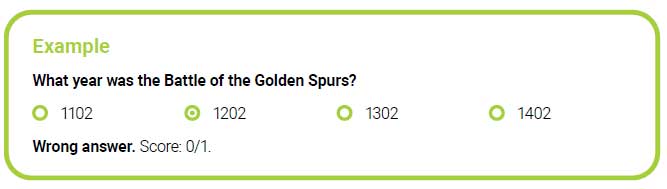
This is the most well-known and commonly used mechanism. With this system, each correct answer receives one point. Wrong answers or unanswered questions score no points. The sum of all the correct answers constitutes the result of the test.
Advantages
- Most well-known and commonly used mechanism
- Simple and transparent
Disadvantages
- Does not take guessing into account
2. Negative marking
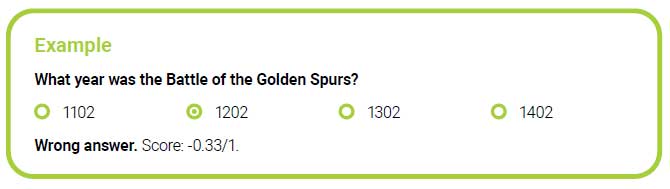
This variant of positive marking is also known as ‘correction for guessing’. With this system, an unanswered question also results in a score of zero, but a wrong answer is “punished” with a negative score. The correct answer, of course, gets a full positive score.
The negative score for a wrong answer is usually equal to -1/( n-1), with ‘n’ being the number of choices available. For a question with 4 choices, a wrong answer therefore scores -1/3.
Advantages
- Takes guessing into account
- Easy to apply
Disadvantages
- Does not measure partial knowledge
- Stress and nerves can affect the result (when a wrong answer is punished, questions are more likely to remain unanswered)
3. Elimination marking
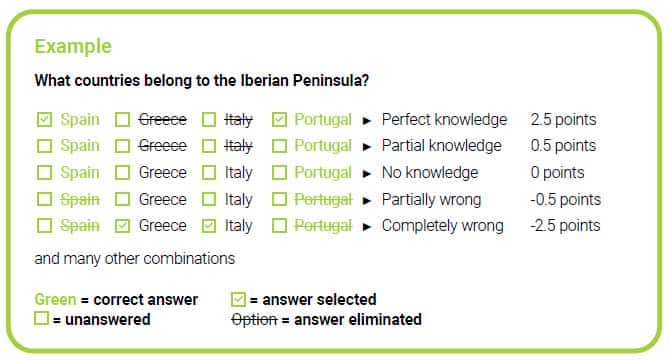
With this mechanism, you reward partial knowledge by allowing multiple answers. This therefore uses a multiple response question. The score participants receive depends on the number of answers they give and whether they also select the right answer.
Advantages
- Does take partial knowledge into account
- Most accurately shows the level of knowledge
Disadvantages
- Guessing is not discouraged
- Requires some explanation to the participants
Determining an appropriate scoring mechanism…
… is not an exact science. Before making a choice, ask yourself the following questions:
- What mechanism fits in best with the type of knowledge I am testing?
- How do I want to deal with guesses?
- How do I want to deal with partial knowledge?
There may also be other factors that influence your choice, such as the culture in your organisation, previous experience with mechanisms and your target audience.
The ideal system does not exist. But if you ask yourself the right questions and consider the advantages and disadvantages of each system, you will undoubtedly make the right choice.